Abraham Lincoln by Seth Grahame-Smith
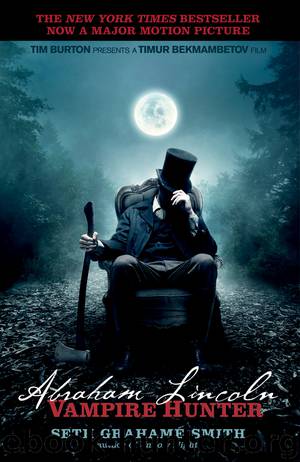
Author:Seth Grahame-Smith [GRAHAME-SMITH, SETH]
Language: eng
Format: epub, mobi
ISBN: 9780446571852
Publisher: Grand Central Publishing
Published: 2010-03-01T16:00:00+00:00
4: NECESSITY KNOWS NO LAW
Lincoln became a tough wartime President, flexing his executive muscles and expanding his war powers whenever necessity demanded. “Necessity,” he argued, “knows no law.” In the exigency of domestic insurrection, he would do whatever he thought imperative to save the country and all it represented. Yet he did not intend to establish a precedent for an “imperial presidency,” one that would allow subsequent chief executives to meddle in the internal affairs of other nations, under the pretext of saving the world. In short, we cannot blame Lincoln for Lyndon Johnson’s disastrous policy in Vietnam. Except for emancipation, Lincoln regarded all of his severe war measures as temporary necessities to end the rebellion and preserve the American experiment, the central idea of the war.
Consider his emergency measures during the eighty days between the outbreak of war and the convening of Congress on Independence Day, 1861. Since rebel forces were threatening to occupy Washington and the nation was on the brink of disintegration, Lincoln met with his Cabinet, and they all decided that they must assume broad emergency powers or let the government fall. Accordingly, Lincoln directed that Secretary of the Navy Gideon Welles empower several individuals—among them his own brother-in-law—to forward troops and supplies to embattled Washington. The President allowed his Secretary of War to authorize the governor of New York and one Alexander Cummings to transport troops and acquire supplies for the public defense. Since Lincoln believed that government departments brimmed with traitors, he himself chose private citizens known for “their ability, loyalty, and patriotism” to spend public money for arms and military preparations. Perhaps these emergency measures were “without authority of law,” Lincoln told Congress later, but he deemed them absolutely necessary to save popular government itself. And his Cabinet unanimously agreed.
With Cabinet approval, Lincoln also declared a blockade of the southern coast, added 22,000 men to the regular army and 18,000 to the navy, called for 42,000 three-year volunteers, and put national armories into full production. As Lincoln subsequently informed Congress, “These measures, whether strictly legal or not, were ventured upon, under what appeared to be a popular demand, and public necessity; trusting, then as now, that Congress would readily ratify them.” When Congress convened in July, it did indeed ratify “all the acts, proclamations, and orders of the President” relating to the army and navy and the volunteers, “as if they had been issued and done under the previous express authority and direction of Congress.” In short, if Lincoln went beyond the letter of the law to save the government, Congress sanctioned his actions.
Generally Congress did the same in the area of martial law and military arrests. From the outset, Lincoln dealt harshly with “the enemy in the rear”—with what he called “a most efficient corps of spies, informers, suppliers, and aiders and abettors” of the rebellion who took advantage of “Liberty of speech, Liberty of the press and Habeas corpus” to disrupt the Union war effort. Consequently, he suspended the writ of
Download
This site does not store any files on its server. We only index and link to content provided by other sites. Please contact the content providers to delete copyright contents if any and email us, we'll remove relevant links or contents immediately.
Red by Erica Spindler(12545)
Crooked Kingdom: Book 2 (Six of Crows) by Bardugo Leigh(12288)
Twisted Palace by Erin Watt(11131)
Mindhunter: Inside the FBI's Elite Serial Crime Unit by John E. Douglas & Mark Olshaker(9287)
Fangirl by Rainbow Rowell(9210)
Never let me go by Kazuo Ishiguro(8846)
All the Light We Cannot See: A Novel by Anthony Doerr(8472)
A Man Called Ove: A Novel by Fredrik Backman(8414)
The Lover by Duras Marguerite(7875)
Confessions of an Ugly Stepsister by Gregory Maguire(7862)
Little Fires Everywhere by Celeste Ng(7167)
The Vegetarian by Han Kang(6273)
To All the Boys I've Loved Before by Jenny Han(5827)
The Shadow Of The Wind by Carlos Ruiz Zafón(5675)
On the Yard (New York Review Books Classics) by Braly Malcolm(5519)
Keepsake: True North #2 by Sarina Bowen(5405)
Dancing After Hours by Andre Dubus(5267)
Ken Follett - World without end by Ken Follett(4705)
The Perks of Being a Wallflower by Stephen Chbosky(4624)
